


Why “Full of Yourself” Specifically
That phrase is chosen consciously or not because it attacks the one thing the envious person most secretly desires: a full self.
The person who is genuinely “full” as I have chosen to be full of purpose, community, vitality, creative expression that represents everything the envious person has quietly starved themselves of. So “full of yourself” is simultaneously:
• An attack on your confidence
• An unconscious confession of their own emptiness
• A demand that you make yourself smaller so the gap between you feels less painful
Psychologist Richard Smith, one of the leading academic researchers on envy, identifies two distinct forms:
Benign envy “I want what you have and it motivates me to grow.” This is healthy and generative.
Malicious envy “I want what you have destroyed so I don’t have to feel this way.” This is what produces the hostile comment, the physical aggression, the cutting remark disguised as honesty.
Malicious envy almost always appears in people who have experienced prolonged helplessness, situations where they genuinely could not choose differently, could not pursue their own desires, could not live fully. Caregiver roles are one of the most documented pathways to this state this is a vivid example.
Yenis Monterrey favorite products HERE
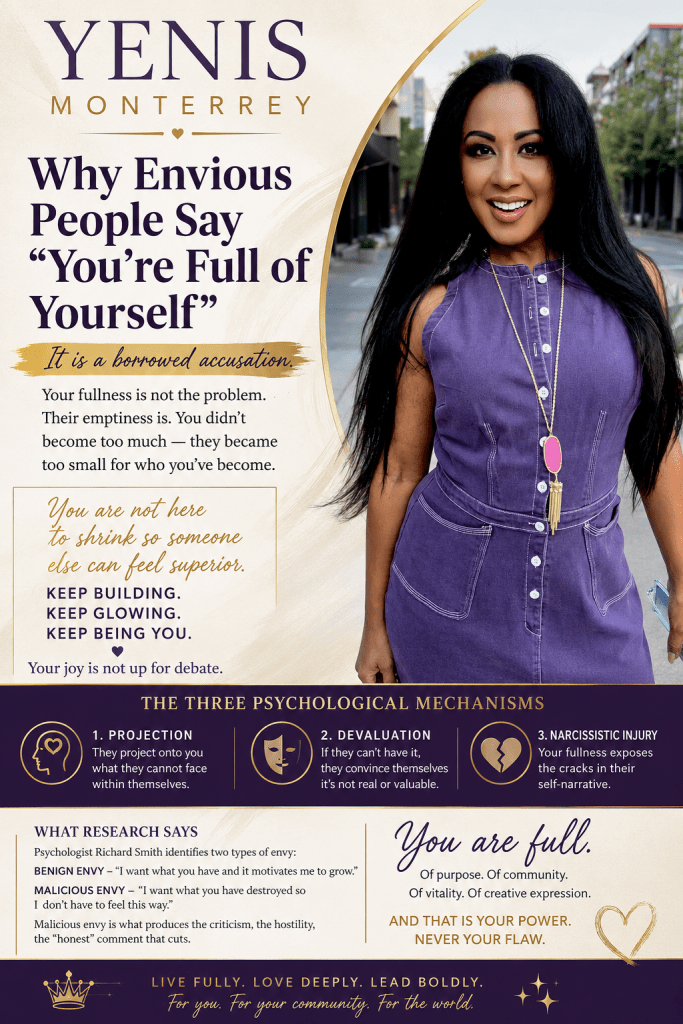
The Single Most Important Thing To Understand : When someone tells you that you are full of yourself in the context of you sharing your community, your wellness, your work, your joy they are giving you a precise clinical report on their own interior landscape.
They are telling you:
“I am empty. And you are the mirror I cannot stand to look into.”
“The most dangerous thing you can do in the presence of a dysregulated person is thrive unapologetically.”
Adapted from polyvagal theory and relational trauma research
The Anatomy of Envy: It Is Never About You
Clinical envy is one of the most misunderstood and underdiagnosed forces in human relationships. Unlike jealousy which involves wanting what another has envy at its most pathological involves the desire to diminish what another has. The envious person does not merely wish they had your vitality, your community, your wellness practice, your career. They wish, on a pre-conscious level, that you did not have it either.
The psychoanalyst Melanie Klein described envy as an attack on goodness itself a primitive rage directed at anything that feels abundant, nourishing, or alive, precisely because it exposes the internal scarcity one has been living with. The person who has spent years in a contracted, self-sacrificing existence does not always respond to your open, expansive life with admiration. They respond with a kind of psychological vertigo and sometimes, with aggression.
“Envy is not about the person being envied. It is the shadow autobiography of the person doing the envying, every complaint a confession of what they have not allowed themselves to become.”
This is why the accusation of being “full of yourself” is rarely an accurate observation. It is almost always a projection a defense mechanism in which the accuser externalizes their own feelings of emptiness onto the person whose fullness is unbearable to witness. In clinical settings, this pattern is recognized as a hallmark of narcissistic injury in individuals with fragile self-structures, often compounded by years of unacknowledged sacrifice and unprocessed grief.
Yenis Monterrey favorite products HERE

When Control Becomes the Only Language
The dysregulated person who cannot metabolize another’s thriving will frequently resort to control as a stabilization strategy. This manifests in recognizable patterns rigid timekeeping enforced through explosive anger, emotional punishment for any deviation from their expectations, boundary violations disguised as affection, and tears deployed as weaponry when logic fails.
These are not the behaviors of a villain. They are the behaviors of a frightened nervous system that never learned to self-regulate one that experiences any disruption to its environment as existential. The ten-minute delay becomes a catastrophe not because punctuality matters that much, but because control is the only tool available to someone who feels perpetually on the edge of falling apart. Research in social comparison theory pioneered by Leon Festinger and expanded extensively in the decades since confirms that upward social comparison triggers the most acute psychological discomfort in individuals with low self-esteem, high baseline anxiety, and a history of self-sacrifice without reciprocal recognition.
The Warning Signs of a Chronically Dysregulated Person in Your Circle
1. Disproportionate emotional reactions
Minor inconveniences a schedule change, a late arrival, an unanticipated plan produce responses calibrated for genuine crisis. The reaction is always larger than the event.
2. Chronic fatigue as identity
Physical exhaustion becomes the organizing narrative of their life, simultaneously generating sympathy and deflecting accountability. Fatigue, in this context, is both real and weaponized.
3. Boundary violations during emotional peaks
Physical intrusion, grabbing, invading personal space especially in the aftermath of a spiritual or cathartic practice that was meant to create openness but instead uncorked unresolved rage.
4. The competitive suffering dynamic
When you share your own struggles, they pivot immediately to their own not in solidarity, but in competition. Your pain is never sufficient. Their sacrifice is always greater.
5. Hostility masked as spiritual authority
Participating in wellness or spiritual practices while exhibiting none of the behavioral integration those practices are designed to cultivate. The practice becomes costume, not transformation.
6. Triangulation and alliance-building
Recruiting other family members to their perspective, sharing grievances as loyalty tests, and creating emotional coalitions that isolate the thriving person.
The Specific Threat of the Woman Who Lives Fully. I’m the person who laugh when confronted by someone who is envious, Why? because they had exposed themselves.
A Clinical Guide: Protecting Your Light Without Extinguishing Theirs
For those who recognize themselves in this narrative who have been accused of shining too brightly by people whose darkness has become their identity the following framework is drawn from evidence-based relational therapy, somatic psychology, and boundary science.
1. Name the dynamic, privately.
Before you can navigate it, you must see it clearly. What you experienced is not a personality conflict. It is a clinical pattern with a name: dysregulated envy expressed as relational aggression. Naming it correctly removes its power to make you question yourself.
2. Regulate yourself first.
Your nervous system will be activated by the encounter. Before any difficult conversation, any family communication, any decision about contact, return to your own regulated state.
3. Compassion does not require access.
You can hold genuine compassion for a person’s suffering while simultaneously limiting or ending your exposure to their dysregulated behavior. These are not contradictory positions. They are the hallmark of healthy relational boundaries.
4. Stop explaining your light.
The person who is threatened by your thriving will not be soothed by your justifications. Explaining why your community matters, why your wellness work is valid, why your success is earned to someone in the grip of envy is offering kindling to a fire. Your life does not require their approval to be legitimate.
5. Choose your witnesses carefully.
Share your growth, your community, your victories with people who have the nervous system capacity to celebrate with you. Not everyone has earned access to your full self. Discernment is not elitism. It is self-preservation.
6. Document physical incidents.
If physical contact occurred grabbing, restraining, forceful touch of any kind The only psychologically and physically safe response to physical aggression is what any trained therapist would prescribe: remove yourself from the space, maintain calm verbal de-escalation without capitulation, and later, establish non-negotiable boundaries regarding future contact. Sympathy for the root cause does not require proximity to the symptom.
7. Seek your own support.
Even the most psychologically sophisticated person benefits from professional support after encounters like these. The goal is not to process the other person’s pathology, but to ensure that their wound does not lodge itself in you.
The clinical literature on post-traumatic growth, on resilience, on the neuroscience of community and belonging, is unanimous on one point: vitality is not a performance. It is a practice. A discipline. A daily decision to remain open, embodied, and present in a world that frequently rewards contraction.
Yenis Monterrey favorite products HERE
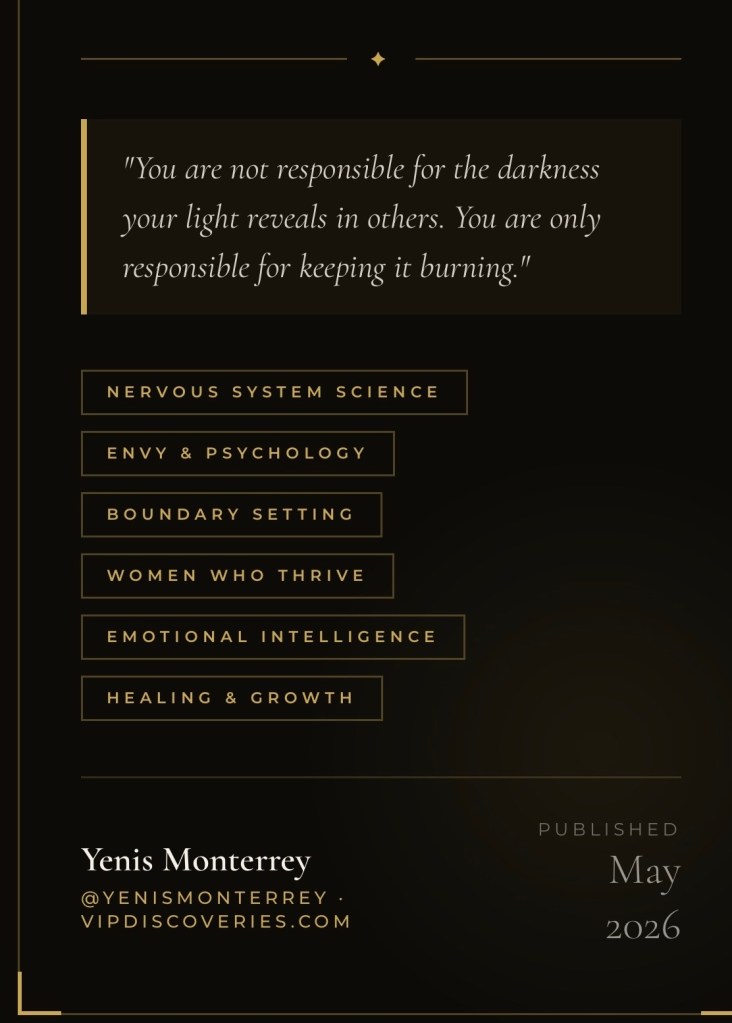
“You are not responsible for the darkness your light reveals in others. You are only responsible for keeping it burning.”
The woman who builds a community of belonging. Who shows up fully for her wellness, her creativity, her relationships, her craft. Who walks into a room and fills it not with ego, but with genuine aliveness is doing something quietly radical. She is refusing to disappear. And some people, tragically, will experience that refusal as a personal offense.

Let them. Your wholeness is not negotiable. This is my motto if you don’t like it. Stay away! Mental Health.
“Keep your light. Protect your peace. And understand, with clinical certainty, that the intensity of their reaction is the truest measure of how brightly you burn.”
Find Yenis Monterrey favorite products HERE
About This Article
This editorial draws on polyvagal theory (Dr. Stephen Porges), attachment and envy research (Melanie Klein, Leon Festinger), somatic trauma frameworks (Dr. Bessel van der Kolk), and evidence-based boundary psychology to provide guidance for individuals navigating relational dynamics with chronically dysregulated individuals. It is intended for educational and reflective purposes and does not constitute clinical advice.
Wellness & The Human Condition · Psychology · Relationships · Growth


 VIP Discoveries
One thought on “ “You’re Full Of Yourself”- When Your Light Triggers Their Darkness”